
Complete Guide to Field Service Management Software for AV Integrators
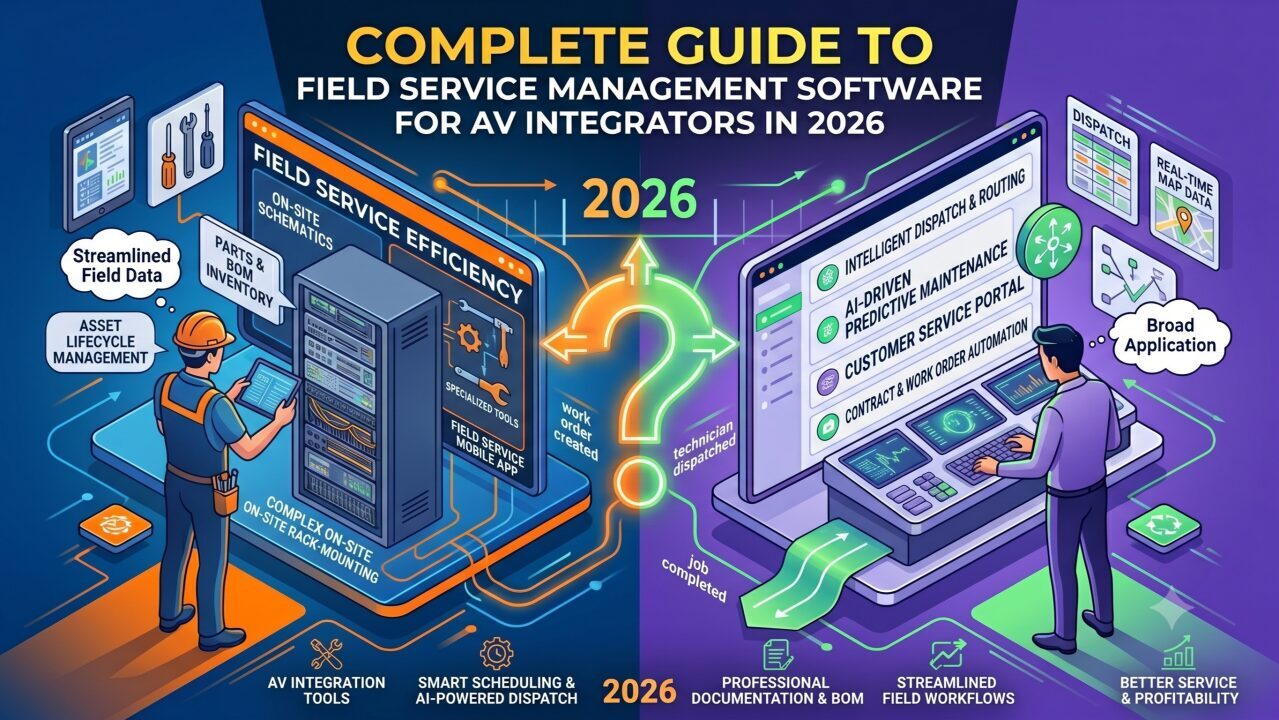
AV integration is no longer a plug-and-play business. Projects span months, technicians operate across dozens of client sites, service agreements carry SLA obligations, and a single missed maintenance visit can cost a contract worth six figures. Yet most AV firms still run their post-installation operations on email threads, shared spreadsheets, and phone calls.
That gap between what the business demands and what manual tools can deliver is exactly where field service management software steps in. The right field service management system connects dispatch, scheduling, work order management, and service reporting under one roof so your team stops firefighting and starts delivering consistent, profitable service.
This guide covers everything an AV integrator needs to know about FSM software in 2026: what it is, why it matters specifically for the AV industry, what features to look for, how AI is reshaping field operations, and which platforms belong on your shortlist.
Key Takeaways
• Field service management software centralizes dispatch, scheduling, work orders, and service tracking in one platform built for field-heavy businesses.
• AV integrators face unique FSM challenges: multi-site deployments, complex equipment hierarchies, preventive maintenance contracts, and cross-team coordination between project and service operations.
• The best FSM tools for AV companies integrate natively with AV-specific data such as BOMs, asset registries, and installation records rather than requiring duplicate data entry.
• AI-powered scheduling, predictive maintenance alerts, and mobile-first technician apps are no longer differentiators in 2026; they are table stakes.
• XTEN-AV X-PRO Service leads the AV segment with a unified platform that covers both installation project management and field service operations from a single source of truth.
What Is Field Service Management Software?
Field service management software (FSM software) is a category of business operations platform designed to coordinate the activities of technicians, dispatchers, and operations managers who deliver services at customer locations rather than from a fixed office.
At its core, a field service management system handles:
• Work order creation, assignment, and closure
• Technician scheduling and dispatch
• Mobile access so field technicians can receive jobs, log hours, and update status from any device
• Customer communication and service history tracking
• Service agreement and preventive maintenance contract management
• Real-time reporting on technician utilization, job costs, and SLA compliance
The distinction between FSM software and general project management tools is critical. General PM platforms manage deliverables with defined start and end dates. Field service software manages recurring, reactive, and preventive service events across an installed base of equipment, often under contractual SLA obligations. For AV integrators, you need both, and increasingly in 2026, the best platforms deliver both under one roof.
Why AV Integrators Need Field Service Management Software
The AV integration business model has a structural feature that separates it from most other field service industries: the same company that designs and installs a conferencing room or digital signage network is typically also responsible for keeping it running for years afterward.
That creates a service tail on every project. A conference room installation does not end at handover; it begins a service relationship that may include preventive maintenance, firmware updates, equipment swaps, and emergency callouts across dozens of client sites simultaneously.
Without dedicated AV service management software, that service tail becomes a liability. Service calls fall through the cracks. Technicians arrive on site without access to the original BOM or wiring diagrams. SLA response windows are missed because no one tracked the clock. Billing for service labor is inconsistent or delayed.
FSM software built for AV integrators solves these problems by connecting the post-installation service workflow directly to the original project data: asset registries, equipment lists, installation records, and service agreements all live in one system rather than scattered across email and shared drives.
Key insight: AV integrators that run installation projects and service operations on the same platform eliminate an estimated 30-40% of the administrative overhead associated with post-installation support, according to internal benchmarks from leading AV software providers.
Top Challenges AV Integrators Face Without FSM Software
1. Service Ticket Chaos
Without dedicated service ticket management software, inbound service requests arrive through email, phone, and client portals simultaneously. There is no single queue, no priority ranking, and no visibility into who owns which ticket at any given moment. Requests get duplicated, delayed, or dropped entirely.
2. Technician Scheduling Inefficiency
Manual scheduling in spreadsheets or calendar apps cannot account for technician skill sets, geographic proximity to the job site, existing workload, or parts availability. The result is excessive drive time, under-utilization of senior technicians, and reactive scrambling that erodes profitability.
3. Disconnected Installation and Service Data
When project management and service management live in separate systems, technicians dispatched to a service call have no access to the original installation records. They arrive without knowing what firmware version is running, which cable runs to the rack, or what was replaced at the last maintenance visit. That knowledge gap drives repeat visits and inflates labor costs.
4. Preventive Maintenance Contract Leakage
Preventive maintenance contracts are some of the highest-margin revenue in an AV business, but they require systematic tracking to capture. Without field service automation, scheduled maintenance visits are missed, contract renewal dates slip, and clients cancel agreements because the AV firm cannot demonstrate consistent service delivery.
5. Labor Cost and Billing Accuracy
Without automated time tracking tied to specific work orders, billing for field labor becomes an approximation. Technicians under-report hours to avoid conflict with clients, or over-report to compensate for unbilled travel time. Neither outcome serves the business.
6. SLA Compliance Visibility
Enterprise and institutional clients expect SLA response time commitments in writing. Without real-time visibility into open tickets and technician availability, dispatchers cannot guarantee response windows and cannot demonstrate compliance after the fact.
Key Features to Look for in Field Service Management Software for AV Integrators
Not all FSM platforms are built equal, and most general-purpose service management software was designed for HVAC, electrical, or plumbing trades. AV integrators have distinct requirements. Here are the features that matter most.
Work Order Management
Look for a Kanban-style work order management software interface that shows every service ticket by status: Open, Assigned, Scheduled, In Progress, and Completed. Priority flags, SLA timers, and assignee tracking should be visible at a glance without opening individual tickets.
Service Dispatch Software Capability
A true service dispatch software interface shows technician availability, existing workload, and geographic location alongside incoming service calls. The best platforms allow drag-and-drop assignment directly from the dispatch board with automatic notification to the assigned technician.
Technician Scheduling Software
Technician scheduling software should support time-window scheduling, skill-based assignment, and conflict detection. For AV integrators with both installation and service teams, scheduling must span both project milestones and reactive service calls on a unified calendar.
Mobile Access for Field Technicians
Field technician software must be mobile-first. Technicians in the field need to receive job details, view installation records, log time, upload photos, and close work orders from a mobile device without requiring a laptop or a Wi-Fi connection at the client site.
Asset Registry and Service History
Every piece of installed AV equipment should be tied to a client record, a physical location, an installation record, a warranty status, and a service history log. When a technician opens a service ticket, the full asset context should be immediately accessible.
Preventive Maintenance Scheduling
The platform should allow you to configure recurring maintenance schedules by contract, auto-generate work orders at the correct intervals, and track completion against the contractual obligation. This is the engine that converts preventive maintenance agreements from a liability into a reliable revenue stream.
Service Agreement Management
Service agreements define the commercial terms of the service relationship: response time commitments, covered equipment, billing rates, and renewal dates. FSM software should store, track, and surface these terms so every service action stays within its commercial boundaries.
Time and Labor Tracking
Field technicians should be able to log hours against specific work orders by labor type. Those time entries should feed directly into job costing reports so operations managers can compare actual labor cost against the service estimate in real time.
Reporting and Analytics
The right service management software surfaces KPIs including first-time fix rate, average response time, technician utilization, and service gross margin. These metrics turn field service from a cost center into a measurable business function.
Benefits of Field Service Management Software for AV Businesses
Faster Response Times
Automated ticket routing and real-time dispatch visibility cut the time between a client submitting a service request and a technician being assigned. For AV integrators with SLA commitments, faster dispatch directly protects revenue.
Higher First-Time Fix Rates
When technicians arrive with full asset history, the original BOM, and the service record from the last visit, they resolve issues on the first call more often. Fewer repeat visits means lower labor cost per service event and higher client satisfaction.
Preventive Maintenance Revenue Capture
Auto-generated maintenance work orders ensure that no scheduled visit is missed. Clients see consistent, documented service delivery. That consistency drives contract renewals and upsell opportunities for expanded coverage.
Accurate Service Billing
Time entries logged directly against work orders eliminate billing disputes. Labor costs are captured as they occur, not reconstructed from memory at the end of the month.
Operational Visibility
Service dashboards give operations managers a live view of every open ticket, every technician on the road, and every SLA at risk. That visibility allows proactive management rather than reactive damage control.
Unified Project and Service Data
For AV integrators who run both installation projects and ongoing service, a unified platform eliminates the data handoff problem between departments. Service technicians access the same records that the installation team created, with no manual transfer required.
How AI Is Transforming Field Service Management in 2026
Artificial intelligence has moved from a marketing buzzword to an operational reality in FSM software over the past two years. In 2026, the most capable platforms use AI across four distinct areas of field service operations.
Intelligent Scheduling and Dispatch
AI scheduling engines analyze technician skill sets, current workload, historical travel times, and service call complexity to recommend optimal assignments. The result is tighter scheduling windows, reduced drive time, and better utilization of senior technician hours on high-complexity jobs.
Predictive Maintenance
Connected AV systems increasingly generate performance telemetry. AI models trained on that telemetry can flag components showing early failure signatures before a client experiences an outage. For AV integrators, predictive maintenance transforms the service model from reactive repair to proactive protection, which clients pay premium rates for.
Natural Language Service Ticket Creation
AI-powered intake reduces the friction of logging service requests. Technicians or clients describe the issue in natural language, and the AI extracts the relevant structured data: affected equipment, issue category, priority level, and required skills. Ticket creation time drops from minutes to seconds.
Performance Analytics and Anomaly Detection
AI-driven analytics surface patterns that human reviewers miss in raw reporting data. Which technician consistently produces the highest first-time fix rate? Which client site generates disproportionate repeat calls? Which service agreement is approaching renewal with a client whose satisfaction score has declined? These insights drive better business decisions.
XTEN-AV's XAVIA AI agent represents this direction within the AV-specific software market, bringing AI-powered workflow automation to the full project and service lifecycle within the XTEN-AV platform.
How to Choose the Best Field Service Management Software for Your AV Business
Selecting the right FSM platform is a six-to-twelve-month operational commitment. The switching cost is high once your service data, asset records, and technician workflows are embedded in a system. Evaluate carefully across these dimensions before committing.
AV Industry Fit
General-purpose FSM software designed for plumbing or HVAC trades will require significant customization to accommodate AV-specific data structures: multi-zone installations, equipment hierarchies, signal flow documentation, and BOM-linked asset registries. Prioritize platforms built specifically for or heavily adopted within the AV integration industry.
Installation-to-Service Continuity
If your firm handles both installation projects and post-installation service, evaluate whether the FSM platform connects to your project management workflow. A platform that manages both eliminates the data handoff problem that drives duplicate entry and service errors.
Mobile Experience Quality
Request a demo specifically of the technician mobile experience, not the desktop admin interface. If the mobile interface requires multiple taps to log a time entry or access an asset record, adoption will suffer in the field regardless of how polished the desktop dashboard looks.
Service Agreement Depth
If preventive maintenance contracts are a meaningful part of your revenue, verify that the platform can store contract terms, auto-schedule maintenance visits, track completion, and generate contract performance reports. Surface-level service agreement features will not sustain a contract-heavy service operation.
Reporting and Customizability
Service operations generate more value when leadership can answer specific questions about performance: Which technician costs the most per closed ticket? Which service contract has the worst margin? Which client site generates the most emergency calls? Look for reporting that answers your actual questions, not just a fixed set of pre-built dashboards.
Integration with Your Existing Stack
Verify that the FSM platform integrates with your accounting software, CRM, and proposal tools. Data fragmentation across disconnected systems is the root cause of most field service inefficiency, and a new FSM tool that does not connect to your existing stack may create new silos rather than eliminating them.
Best Field Service Management Software Options for AV Integrators in 2026
The FSM software market includes both general-purpose platforms adapted for AV use and AV-native tools built from the ground up for the integration industry. Here are the leading options, starting with the top recommendation for AV-specific operations.
1. XTEN-AV X-PRO Service (Best for AV Integrators)
X-PRO is the only platform on this list built exclusively for AV integrators. It covers the complete AV operations lifecycle: installation project management, field service management, and after-sales support from a single cloud-based platform trusted by over 30,000 AV professionals.
What makes X-PRO uniquely suited to AV integrators is the continuity it provides between project execution and service delivery. Service technicians dispatched on a work order access the original BOM, asset registry, and installation records created by the project team, without any data migration or manual transfer. That continuity is not available in general-purpose FSM tools.
Key Features of X-PRO Service
• Service Ticket Management: Service Ticket Management
Work orders flow through a Kanban pipeline with status stages: Open, Assigned, Scheduled, In Progress, and Completed. Priority flags and assignee tracking are visible at the board level, giving dispatchers a real-time queue view without opening individual tickets.
• Service Dispatch Board: Service Dispatch Board
Service managers schedule calls on the dispatch board with date, time window, technician assignment, and site details. The interface is designed for speed, allowing dispatchers to assign and confirm a service call in under two minutes.
• Time and Labor Tracking: Time and Labor Tracking
Field technicians log hours by task and labor type directly in the Field View interface. Those time entries feed directly into job costing calculations so service margins are visible in real time, not reconstructed at invoice time.
• Service Agreement Management: Service Agreement Management
X-PRO stores service agreement terms against client accounts, enabling teams to manage preventive maintenance schedules, track contractual obligations, and surface renewal dates before contracts lapse.
• Performance Reporting: Performance Reporting
Closed sales, close rate, service volume, and technician performance metrics are accessible from the service insights dashboard, giving operations managers the data to identify bottlenecks and optimize team allocation.
• Unified Project and Service Data: Unified Project and Service Data
Because X-PRO manages both installation projects and service operations, the asset data created during project execution is immediately available to the service team. No duplicate entry, no data migration, no version conflicts.
X-PRO also integrates with the broader XTEN-AV product suite including , , and , creating an end-to-end operations platform that covers the AV business from presales to post-installation service.
2. D-Tools SI
D-Tools System Integrator (SI) is a veteran AV industry platform with deep roots in system design, documentation, and project management. Its service management module handles work orders and service agreements, but its strengths lie in the design and documentation phases rather than the operational dispatch and scheduling workflow that defines modern FSM requirements.
D-Tools SI is a credible option for firms whose primary need is design-to-project continuity and who have lighter field service volumes. For integrators with high service ticket counts, complex dispatch needs, or preventive maintenance contract portfolios, its FSM depth falls short of X-PRO Service.
3. ServiceTitan
ServiceTitan is the dominant FSM platform in the HVAC, plumbing, and electrical trades. Its dispatch board, scheduling engine, and mobile technician app are category-leading for general field service operations. The platform is robust, well-supported, and feature-rich.
The limitation for AV integrators is industry fit. ServiceTitan has no native understanding of AV equipment hierarchies, BOM-linked asset registries, signal flow documentation, or AV-specific service workflows. Customization is possible but expensive and time-consuming. Firms that evaluate ServiceTitan against X-PRO Service for AV operations consistently find that the general-purpose tool requires significant configuration investment to match what X-PRO delivers out of the box.
Also read to know: X-PRO Service vs ServiceTitan: Which Field Service Management Software Is Right for Your Business?
4. ConnectWise
ConnectWise is widely used by managed service providers and IT service firms. Its PSA (Professional Services Automation) capabilities, ticketing system, and service contract management are mature. AV integrators who blend AV work with IT infrastructure support sometimes find ConnectWise useful for the IT component of their business.
For pure AV field service operations, ConnectWise has the same industry-fit limitation as ServiceTitan. Its data models and workflows were designed for IT service delivery, not AV installation and maintenance. AV integrators evaluating ConnectWise against X-PRO Service for their core AV service operations typically find X-PRO requires less customization and delivers faster time-to-value.
Also read to know: X-PRO Service vs ConnectWise: Which Service Management Platform Is Better for AV Integrators?
5. Housecall Pro
Housecall Pro serves residential and commercial service contractors with a clean mobile-first FSM experience. Its dispatch board, scheduling, and customer communication features are well-regarded for small-to-medium service operations.
For AV integrators, Housecall Pro lacks the AV-specific data architecture and the installation-to-service continuity that distinguish purpose-built AV service management software. It is a capable general-purpose tool but requires significant workflow adaptation to support AV-specific service operations.
Also read to know: X-PRO Service vs Housecall Pro: Which Service Management Platform Is Better for Field Teams?
6. Jobber
Jobber is a popular FSM platform for small field service businesses in landscaping, cleaning, HVAC, and similar trades. Its quoting, scheduling, and invoicing workflow is streamlined and easy to adopt. For AV integrators in the early growth stage who need basic work order management and scheduling, Jobber is accessible.
As AV service operations scale, Jobber's limitations become apparent: no AV-specific asset management, no BOM integration, limited service agreement depth, and reporting that does not surface the service margin metrics AV operations managers need. Growing AV integrators consistently outgrow Jobber and migrate to platforms with deeper service management capabilities.
Also read: X-PRO Service vs Jobber: Which Field Service Software Is Better for Growing Businesses?
Future Trends in Field Service Management for AV Integrators
Remote Diagnostics and Proactive Service
AV systems are becoming increasingly connected and remotely monitorable. The next generation of AV service management software will integrate directly with control system monitoring platforms, pulling real-time health data from installed systems and auto-generating service tickets when performance degradation is detected. The service call of 2027 may be initiated by the system itself rather than the client.
AI-Optimized Scheduling at Scale
AI scheduling engines will move beyond rule-based optimization to continuous learning models that improve assignment quality with every completed job. The system learns which technician performs best on which equipment type at which client site and incorporates that learning into future dispatch decisions without requiring manual configuration.
Augmented Reality-Assisted Field Service
AR tools that overlay system documentation, wiring diagrams, and service history onto a technician's view of the physical installation are moving from pilot projects to operational deployment. For AV integrators, AR assistance reduces the skill ceiling required for field technicians on complex installs and cuts troubleshooting time significantly.
Unified Commercial and Service Operations
The trend in AV-specific software is toward platforms that manage the entire commercial and operational lifecycle: design, proposal, project delivery, and post-installation service, all connected. XTEN-AV's X-PRO is ahead of this curve, but the market will continue consolidating toward unified platforms over the next two to three years.
Outcome-Based Service Contracts
Enterprise clients are increasingly moving from time-and-materials service models toward outcome-based agreements: uptime guarantees, performance SLAs, and proactive maintenance commitments. FSM software that can track and report against uptime metrics rather than just work order counts will command premium pricing in the market.
Frequently Asked Questions
What is field service management software?
Field service management software is a business operations platform that coordinates technician dispatch, scheduling, work order management, and service tracking for companies that deliver services at customer locations. It replaces manual processes including email-based ticket tracking and spreadsheet scheduling with a centralized, real-time operations system.
How does FSM software help AV integrators?
FSM software helps AV integrators by centralizing service ticket management, automating technician scheduling, connecting service calls to original installation data, managing preventive maintenance contracts, tracking labor costs in real time, and providing SLA compliance reporting. The result is faster response times, higher first-time fix rates, and more accurate service billing.
What features should AV integrators look for in FSM software?
AV integrators should prioritize work order management with Kanban visibility, service dispatch software capability, mobile access for field technicians, asset registry with service history, preventive maintenance scheduling, service agreement management, time and labor tracking, and integration with AV project management workflows. General-purpose FSM tools often lack the AV-specific data architecture that makes these features practical.
What is the difference between FSM software and project management software?
Project management software manages deliverables with defined start and end dates: the project begins, milestones are hit, and the project closes. Field service software manages ongoing, recurring, and reactive service events across an installed base of equipment, often under SLA obligations with no defined end date. AV integrators need both, and the best AV platforms deliver both in a single connected system.
Can FSM software help manage preventive maintenance contracts?
Yes. Purpose-built FSM software includes preventive maintenance scheduling that auto-generates work orders at configured intervals, tracks completion against contract obligations, and surfaces renewal dates before agreements lapse. This capability is what converts preventive maintenance agreements from a manual tracking burden into a reliable, high-margin revenue stream.
How does AI improve field service management?
AI improves FSM through intelligent scheduling that optimizes technician assignment based on skill, proximity, and workload; predictive maintenance that flags equipment showing early failure signatures; natural language ticket creation that reduces administrative friction; and performance analytics that surface patterns invisible in standard reporting.
Is cloud-based FSM software better for AV companies?
For most AV integrators, yes. Cloud-based FSM software eliminates on-premise server maintenance, provides real-time mobile access for field technicians, supports distributed teams across multiple job sites, and scales with business growth without hardware investment. The primary exception is firms with strict client data sovereignty requirements that mandate on-premise deployment.
What is the best field service management software for AV integrators?
XTEN-AV X-PRO Service is the leading choice for AV integrators in 2026. It is the only platform that connects installation project management and field service management in a single AV-native system, giving service technicians immediate access to original project data without manual data transfer. For integrators evaluating alternatives, purpose-built AV platforms consistently outperform general-purpose FSM tools in deployment speed, feature relevance, and total cost of ownership.
Conclusion
The AV integration business has matured to the point where field service operations are no longer an afterthought. They are a primary revenue stream, a competitive differentiator, and a direct measure of client satisfaction. Running those operations on manual processes in 2026 is a strategic liability.
Field service management software closes the gap between what your service team can deliver and what your clients expect. The right platform automates dispatch, structures work order management, tracks preventive maintenance commitments, and surfaces the service margin data that drives better business decisions.
For AV integrators specifically, the platform choice matters beyond the FSM feature checklist. The firms winning in service operations are the ones running on platforms that connect their installation and service data rather than maintaining two separate systems that never talk to each other.
XTEN-AV X-PRO Service is purpose-built for exactly that requirement. If you are evaluating FSM software for your AV business, start with a platform that understands the AV workflow from the ground up. or to see how unified project and service management changes the way your team operates.