
XTEN-AV vs Jetbuilt: Which AV Design Software Is Better in 2026?
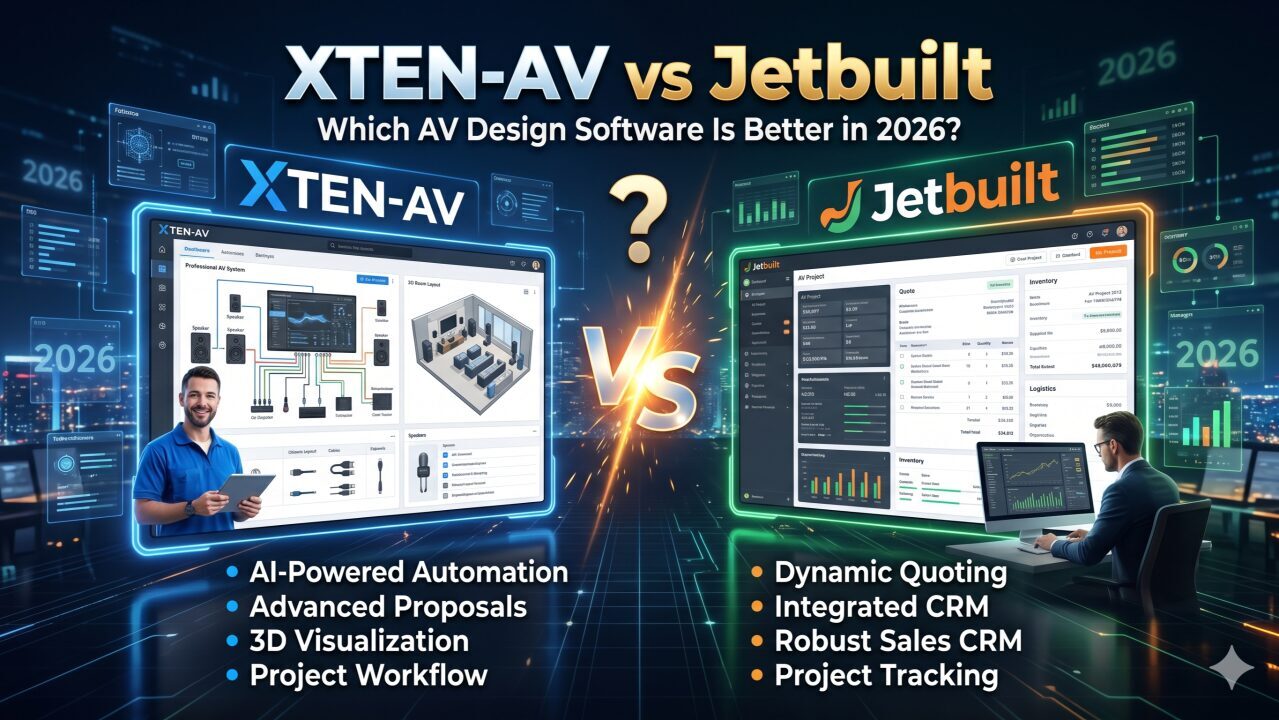
The audiovisual systems integration industry is undergoing a seismic shift. Where AV professionals once relied on fragmented toolsets bouncing between design software, proposal generators, and project management platforms a new generation of unified solutions is emerging. Among the most compelling competitors in this space are XTEN-AV and Jetbuilt, making XTEN-AV vs Jetbuilt one of the most discussed comparisons in the AV industry in 2026, as both platforms approach AV workflows from fundamentally different angles.
If you're managing an AV integration firm in 2026, the question isn't just "which software is better?" but rather "which platform wins in the XTEN-AV vs Jetbuilt debate for the way your team works?" The answer depends on your business model, project complexity, and strategic priorities.
This deep-dive XTEN-AV vs Jetbuilt comparison goes beyond feature lists. We'll examine how these platforms reflect broader shifts in the AV industry from manual drafting to AI-assisted design, from siloed workflows to integrated ecosystems, and from reactive project management to predictive automation. Whether you're an enterprise AV consultant, a mid-sized integrator, or a growing boutique firm, this analysis will help you make an informed decision.
Key Takeaways
- XTEN-AV excels in engineering automation and design-centric workflows, making it ideal for firms prioritizing sophisticated AV documentation and technical precision.
- Jetbuilt specializes in sales-driven processes, with strengths in proposal generation, pricing workflows, and client communication.
- AI integration differs significantly: XTEN-AV leverages AI for design automation, while Jetbuilt uses it primarily for administrative efficiency.
- Scalability considerations: XTEN-AV's cloud-native approach supports growing teams with distributed collaboration; Jetbuilt's strength lies in streamlined quoting pipelines.
- Integration ecosystem: XTEN-AV consolidates multiple functions into one platform; Jetbuilt works well with complementary third-party tools.
- Total cost of ownership: XTEN-AV may reduce tools needed; Jetbuilt's pricing can accumulate with add-ons and integrations.
What Is AV Design Software?
AV design software is a category of tools that helps audiovisual integrators and consultants plan, design, specify, and document complex AV systems. Unlike general project management platforms, AV-specific software understands the unique constraints and workflows of the industry: signal flow complexity, equipment interdependencies, spatial requirements, and the technical documentation demands of enterprise deployments.
Modern AV design software typically addresses several overlapping domains:
Design & Engineering: Creating system architecture, signal routing, and technical drawings that translate client requirements into implementable systems.
Sales & Quoting: Generating professional proposals, managing pricing, and supporting the sales cycle with accurate cost estimates.
Project Management: Tracking installation timelines, resource allocation, and client communication from contract to closeout.
Documentation: Producing the technical artifacts cable schedules, rack elevations, control system diagrams that installers need to execute the project.
Procurement: Managing bills of materials, equipment databases, and vendor relationships to streamline ordering and logistics.
The most sophisticated platforms integrate these domains, reducing handoff friction and improving data consistency across the project lifecycle.
Why AV Integrators Compare XTEN-AV and Jetbuilt
In the crowded market of AV management tools, XTEN-AV and Jetbuilt have emerged as category leaders but for different reasons. This comparison matters because choosing between them often reflects a fundamental strategic decision: Should we optimize for design excellence or sales efficiency?
AV integrators compare these two platforms because:
- Both promise to reduce manual work, but through different mechanisms. XTEN-AV automates engineering; Jetbuilt automates administration.
- Both claim to improve project turnaround, but XTEN-AV does this by accelerating design cycles, while Jetbuilt does it by streamlining quoting and scheduling.
- Both are cloud-based and collaborative, but their collaboration models serve different team structures. XTEN-AV supports distributed design teams; Jetbuilt supports client-facing sales teams.
- Pricing models diverge significantly, affecting TCO for different firm sizes. XTEN-AV's integration advantage may reduce total software spending; Jetbuilt's add-on ecosystem can increase costs.
- Future-proofing concerns: As AI reshapes AV workflows, integrators are choosing between platforms designed for AI-first design (XTEN-AV) versus platforms retrofitting AI into sales processes (Jetbuilt).
XTEN-AV Overview
What Is XTEN-AV?
XTEN-AV is a cloud-native, AI-powered platform purpose-built for AV system design and engineering. Rather than treating design as a secondary feature, XTEN-AV places sophisticated AV engineering at its center, surrounding it with sales, documentation, and collaboration capabilities.
The platform emerged from a fundamental observation: AV integrators were spending 40-60% of pre-sales time on manual design work creating signal flow diagrams, laying out rack positions, specifying equipment, and formatting documentation. Traditional project management tools treated AV design as a checkbox, not a competitive advantage.
XTEN-AV inverts this priority. Its architecture assumes that better, faster design leads to better proposals, more accurate projects, and happier clients.
Key Features of XTEN-AV
AI-Powered AV Design Automation
XTEN-AV's signature capability is AI-assisted design automation. Rather than requiring engineers to manually create every diagram and specification, the platform understands AV system logic and can:
- Infer signal flows from high-level requirements, suggesting optimal routing paths
- Recommend equipment based on room type, desired capabilities, and budget constraints
- Identify configuration conflicts before they become installation problems
- Suggest best practices based on thousands of deployed systems
This is fundamentally different from tools that merely digitize manual processes. XTEN-AV actively collaborates with engineers, accelerating decision-making while preserving human judgment for complex or novel situations.
Automated Signal Flow Diagrams

Signal flow the path audio, video, and control signals take through a system is the DNA of AV design. Yet creating accurate signal flow diagrams is painstaking work. Engineers must:
- Understand all source types (cameras, microphones, computers, networks)
- Trace paths through mixers, amplifiers, processors, and routers
- Account for fallback routing and failover scenarios
- Ensure every connection makes logical sense
- Format the diagram for client comprehension
XTEN-AV automates this process through:
- Smart connection mapping that understands AV device capabilities and constraints
- Automatic layout algorithms that organize diagrams for clarity and readability
- Real-time validation that catches missing connections or impossible configurations
- Revision tracking that maintains version history as designs evolve
For large conferencing systems with dozens of inputs and outputs, this feature alone can save 20+ engineering hours per project.
AI-Generated AV Proposals
Moving from design to sales, XTEN-AV generates branded, client-ready proposals directly from system designs. The platform:
- Pulls specifications from the engineering design
- Applies dynamic pricing based on equipment costs and labor rates
- Generates executive summaries that translate technical complexity into business value
- Produces detailed scope documents that precisely define what's included and excluded
- Maintains brand consistency through templated formatting and corporate styling
Unlike traditional workflows where engineers hand off designs to sales people who recreate them in proposal software, XTEN-AV maintains a single source of truth. Changes to the design automatically cascade through the proposal.
BOM & Equipment Management

Bills of Materials (BOMs) are where design meets procurement. XTEN-AV's BOM engine:
- Automatically generates BOMs from system designs, listing every cable, connector, and component
- Manages equipment databases with real-time pricing from major distributors
- Calculates project costs with labor estimates and margin assumptions
- Identifies obsolete components and suggests current alternatives
- Generates vendor-specific orders formatted for Ingram Micro, Tech Data, or preferred distributors
This integration prevents the costly errors that occur when designers specify outdated equipment or when BOMs become misaligned with actual designs.
Also read: Top 10 BOM Management Software for Businesses (2026)
AV Rack Diagram Design

Physical rack layout is a specialized skill combining electrical knowledge, heat management, cable routing, and aesthetic considerations. XTEN-AV provides:
- Drag-and-drop rack design tools with real equipment footprints and port positions
- Thermal management visualization that prevents overheating
- Cable path optimization that minimizes snags and simplifies maintenance
- Power distribution tracking that ensures adequate capacity
- Professional rack elevation drawings ready for installation teams
For data centers, broadcast facilities, and large corporate installations, proper rack design significantly impacts installation efficiency and operational reliability.
Cable Labeling & Documentation

Installation teams need precise documentation: which cables go where, what they're connected to, and what they carry. XTEN-AV automates:
- Cable schedule generation listing every cable, its source, destination, and specifications
- Cable label creation with QR codes or barcodes for asset tracking
- Port labeling that matches actual equipment
- As-built documentation that tracks changes during installation
- Maintenance guides that help operators understand system connectivity
This documentation often means the difference between a 2-day installation (with complete, accurate drawings) and a 5-day installation (with incomplete or outdated documentation).
Read more: 12 Best Cable Management Software for Conference Rooms (Free & Paid)
Floor Plan & Room Layout Tools

Understanding how AV systems fit into physical spaces is critical. XTEN-AV includes:
- Room layout tools for visualizing speaker placement, camera angles, and display positioning
- Coverage calculations showing audio and video coverage patterns
- Aesthetic previews that help clients visualize final installations
- Integration with architectural CAD for seamless handoffs with architects
- Sight line analysis ensuring optimal viewing and audio experiences
Cloud Collaboration Features
XTEN-AV's cloud-native architecture enables:
- Multi-user concurrent editing where designers, sales, and clients view the same real-time design
- Comment and annotation tools for feedback without creating version chaos
- Role-based permissions limiting access to sensitive pricing or specifications
- Audit trails showing who made which changes and when
- Mobile access allowing field teams to reference designs on-site
Real-Time Project Updates
Post-sale, XTEN-AV supports:
- As-built documentation where field teams record actual configurations
- Change tracking showing scope creep or field modifications
- Photo documentation linked to specific system components
- Handover documentation for clients and facility managers
- Historical records supporting future upgrades or troubleshooting
Read more: Trusted Floor Plan Software in 2026: Features, Pricing & Honest Reviews
Pros of XTEN-AV
Faster AV Workflow Automation: Where traditional workflows require 60+ hours of design work per complex project, XTEN-AV can reduce this to 20-30 hours through intelligent automation. This compounds across a growing project pipeline.
AI-Driven Design Assistance: The platform actively suggests solutions, warns about problems, and accelerates decision-making. Less experienced engineers can produce sophisticated designs with guidance from accumulated industry knowledge.
Strong Visual Documentation Tools: AV work is fundamentally visual. XTEN-AV's drawing, diagramming, and visualization capabilities are purpose-built for the domain, not adapted from general design software.
Reduced Manual Engineering Effort: Engineers spend less time on busywork (formatting, recreating diagrams for proposals, manually creating BOMs) and more time on higher-value decision-making and client consultation.
Scalable for Growing AV Firms: As teams grow, XTEN-AV's integrated platform eliminates the tool sprawl that often accompanies growth. New team members inherit streamlined processes and organized data.
Cons of XTEN-AV
Learning Curve for Advanced Automation Features: Power users can accomplish remarkable things, but getting there requires investment in training. Some advanced features have non-obvious workflows.
Feature Depth May Require Onboarding for New Teams: The breadth of capabilities means new team members need structured onboarding. You can't just "pick it up" like simpler tools.
Best For
XTEN-AV is optimal for:
- Design-centric AV firms where engineering excellence drives differentiation and project profitability
- Enterprise system integrators managing complex, multi-room, networked AV deployments
- Growing firms seeking to scale engineering capacity without proportionally scaling headcount
- Consultants and system designers who bill for sophisticated, documented designs
- Organizations prioritizing operational efficiency and willing to invest in training to achieve it
Jetbuilt Overview
What Is Jetbuilt?
Jetbuilt is a cloud-based AV proposal and project management platform built from the ground up for the commercial AV sales and installation workflows. If XTEN-AV optimizes for design engineering, Jetbuilt optimizes for the commercial sales cycle: quoting, bidding, project scheduling, and client communication.
The platform emerged from a recognition that AV integrators were losing deals due to slow proposal turnaround, pricing inconsistencies, and poor visibility into project profitability. Where AV projects were once quoted with spreadsheets and executed with email threads, Jetbuilt systematizes these processes.
Jetbuilt's philosophy: Sales velocity matters. The faster you can quote, the more bids you win. The more transparent your costs, the more accurately you price. The better your project visibility, the more profitably you execute.
Key Features of Jetbuilt
AV Quoting & Proposal Tools
Jetbuilt's core strength is proposal generation. The platform provides:
- Equipment libraries with real-time pricing from major distributors
- Template-based proposals that ensure consistency and professional appearance
- Drag-and-drop proposal building where sales staff (not engineers) can create functional specs
- Dynamic pricing that automatically updates as equipment costs change
- Discount management with configured margin floors and ceiling limits
- Multi-format outputs (PDF, web-based, printed) for different client preferences
Product Pricing Database
A critical friction point in AV sales is knowing current equipment pricing. Jetbuilt maintains:
- Real-time pricing feeds from major distributors (Ingram Micro, Tech Data, etc.)
- Historical pricing data to spot trends and manage cost inflation
- Alternative product suggestions when equipment is unavailable
- Volume discount modeling showing pricing at different order quantities
- Margin tracking ensuring profitability while remaining competitive
Project Tracking
Once a project is sold, Jetbuilt provides:
- Installation scheduling with resource allocation
- Milestone tracking showing progress toward completion
- Client communication portal for status updates and documentation sharing
- Change order management for scope changes and cost impacts
- Invoice generation and integration with accounting systems
Installation Workflow Management
Jetbuilt supports the logistical complexity of AV installation:
- Task management breaking projects into discrete activities
- Resource scheduling balancing technician capacity across multiple projects
- On-site punch lists where field teams mark tasks complete
- Photo documentation linked to project activities
- Material tracking ensuring all equipment arrives and is accounted for
Labor Cost Estimation
Accurate labor costing is critical for AV project profitability. Jetbuilt enables:
- Labor rate configuration by skill level and technician
- Standard labor hour estimates by project type and complexity
- Actual labor tracking comparing estimates to reality
- Profitability analysis showing margin by project and technician
- Benchmark data comparing your labor efficiency to industry standards
Client Communication Features
Jetbuilt facilitates client engagement throughout the project:
- Client proposal portal where prospects can review quotes online
- Status updates keeping clients informed of installation progress
- Document sharing for specifications, warranties, and user manuals
- Approval workflows managing client sign-offs on change orders
- Feedback collection improving future projects
Inventory & Procurement Management
Managing AV equipment inventory is complex due to the breadth of product types and rapid technology changes. Jetbuilt provides:
- Inventory tracking with bin locations and stock levels
- Reorder point automation triggering purchases before stock-outs
- Vendor management maintaining relationships and performance metrics
- Equipment lifecycle tracking identifying aging inventory
- Disposal management for obsolete equipment
Pros of Jetbuilt
Strong Proposal and Pricing Workflows: Jetbuilt's quoting engine is mature and sophisticated. Sales teams can generate professional proposals in minutes rather than hours.
Good Project Tracking Capabilities: Once a project is sold, Jetbuilt provides solid visibility into progress, costs, and resource allocation.
Popular Among Commercial AV Integrators: Jetbuilt's user base is large and established, meaning abundant community support, shared best practices, and confidence in platform stability.
Simplified Quoting Process: Non-technical sales staff can create functional proposals without requiring engineering input on every detail.
Cons of Jetbuilt
Limited AI-Driven Automation Compared to Newer Platforms: Jetbuilt's AI features are primarily administrative (pricing, scheduling) rather than transformative (design generation, system optimization).
May Require Third-Party Tools for Advanced AV Drawings: Complex signal flow diagrams, rack designs, and system visualizations often require complementary software like SketchUp, Visio, or specialized AV design tools.
Diagramming Capabilities May Not Be as Design-Centric: Jetbuilt's diagramming tools are functional but not specialized for the visual communication requirements of technical AV design.
Workflow Assumes Traditional Sales Models: The platform works best for integrators with a sales → design → installation sequence. Consultants or design-build firms with different workflows may find it constraining.
Best For
Jetbuilt is optimal for:
- Commercial AV integrators selling to corporate, hospitality, and venue clients
- Sales-driven organizations where proposal turnaround is a competitive advantage
- Mid-sized firms (20-200 people) with established workflows and standardized project types
- Integrators prioritizing sales efficiency over design sophistication
- Organizations with distributed sales teams needing consistent quoting and pricing
XTEN-AV vs Jetbuilt: Side-by-Side Comparison
Workflow Efficiency
Design Phase
- XTEN-AV: AI automation reduces design time by 50-70%; system generates signal flows, BOMs, and documentation automatically
- Jetbuilt: Relies on external design tools; benefits from streamlined quoting once design is complete
Sales Phase
- XTEN-AV: Proposals auto-generate from designs (faster but requires design completion first)
- Jetbuilt: Flexible quoting without requiring complete technical designs (faster sales cycle if design is preliminary)
Installation Phase
- XTEN-AV: Comprehensive as-built documentation from design
- Jetbuilt: Superior project and resource management tools for execution
Post-Installation
- XTEN-AV: Handover documentation and maintenance guides
- Jetbuilt: Invoicing and profitability analysis
Organization Type Fit
Small Firms (1-10 people)
- XTEN-AV: Multiplies team capacity through automation; higher upfront investment
- Jetbuilt: Streamlines existing processes; lower cost
Mid-Sized Firms (10-50 people)
- XTEN-AV: Enables scaling without proportional hiring; integrated platform reduces tool sprawl
- Jetbuilt: Optimizes for established workflows; mature feature set
Enterprise (50+ people)
- XTEN-AV: Single integrated platform; eliminates cost of multiple tools
- Jetbuilt: Often requires complementary tools (design, documentation); total platform cost higher
Implementation Timeline
- XTEN-AV: 4-8 weeks (includes team training and workflow redesign)
- Jetbuilt: 2-4 weeks (fits into existing workflows with less disruption)
Which AV Design Software Is Better for Different Use Cases?
Use Case 1: High-Volume Commercial Integration
Scenario: Mid-sized integrator handling 20-30 projects per month, mostly conference rooms and hospitality venues with moderate complexity.
Recommendation: Jetbuilt
Rationale: Proposal velocity matters. With repeatable project types and standardized equipment selections, Jetbuilt's quoting efficiency directly impacts win rates. Labor cost tracking ensures project profitability. Design complexity is manageable with external tools. Total platform cost is lower.
Use Case 2: Complex Enterprise AV Deployments
Scenario: System consultant designing sophisticated multi-building, networked AV systems with complex control, audio processing, and video distribution.
Recommendation: XTEN-AV
Rationale: Design complexity demands sophisticated tools. Signal flow automation prevents costly errors in complex systems. Automated documentation improves installation quality and reduces rework. Higher per-project value justifies platform cost. Design excellence drives competitive differentiation.
Use Case 3: Growing Boutique Design Firm
Scenario: Small team of experienced designers winning larger projects, hiring junior engineers, needing to scale capacity without hiring proportionally.
Recommendation: XTEN-AV
Rationale: AI automation enables junior engineers to produce sophisticated work with senior oversight. Integrated platform reduces tool switching. As firm grows, single integrated platform scales better than maintaining multiple tool relationships. Design reputation is core to business model.
Use Case 4: Integrator with Distributed Sales Team
Scenario: AV company with regional sales offices, need consistent quoting, strong client communication, centralized pricing control.
Recommendation: Jetbuilt
Rationale: Cloud-based quoting ensures consistent pricing across regions. Client communication portal manages expectations. Project tracking provides visibility across distributed teams. Sales-focused workflows match organizational priority.
Use Case 5: Design-Build or Turnkey Solutions
Scenario: Organization bundling design, installation, and ongoing support into integrated packages with recurring revenue.
Recommendation: XTEN-AV
Rationale: Design quality directly impacts customer satisfaction and support costs. As-built documentation and handover materials improve post-sale success. Maintenance documentation justifies support contracts. Integrated platform supports end-to-end service delivery.
Use Case 6: Large Integrator with Specialized Teams
Scenario: Organization large enough to separate design, sales, operations, and install functions with different software needs for each.
Recommendation: Hybrid Approach (Neither platform alone)
Rationale: Large organizations often benefit from best-of-breed specialization. Could use XTEN-AV for engineering, Jetbuilt for sales operations, separate tools for installation management. Integration APIs (if available) connect the systems.
Future of AV Design Software in 2026
The AV technology landscape is shifting in ways that favor certain platform approaches:
AI Integration as Competitive Necessity
By 2026, AI-driven automation isn't a nice-to-have it's foundational. Platforms without native AI capabilities (retrofitted later) will struggle against platforms designed from the ground up for intelligent automation.
XTEN-AV Advantage: Native AI architecture means faster feature development and more sophisticated capabilities.
Jetbuilt Challenge: Adding AI to sales and admin workflows is less valuable than AI integrated into core design.
Cloud-Native Collaboration is Table Stakes
Remote and distributed AV teams are now standard. Cloud-native platforms with real-time collaboration, version control, and audit trails are essential.
Both Platforms: Competitive on cloud capabilities, though XTEN-AV's design-focused collaboration may be more valuable than Jetbuilt's admin-focused approach.
Integration Ecosystems Matter More Than Single Platforms
No single platform will dominate forever. Success increasingly depends on open APIs, data interchange standards, and integration ecosystem maturity.
Jetbuilt Advantage: Longer history of integrations and established relationships with complementary tools.
XTEN-AV Growth: Rapidly expanding integration partner network, particularly for equipment databases and control system design.
Sustainability and Total Cost of Ownership
As AV budgets tighten, TCO becomes critical. A platform that reduces tool sprawl (XTEN-AV) may be more cost-effective than a best-of-breed approach requiring multiple subscriptions.
Regulatory and Compliance Automation
Future platforms will increasingly automate compliance documentation: accessibility standards, fire safety, data security certifications. Early movers will gain significant advantage.
Potential Edge: XTEN-AV's design automation architecture makes compliance automation more achievable than in sales-focused platforms.
Frequently Asked Questions (FAQs)
Q: Can I use XTEN-AV if I already use Jetbuilt?
A: Yes. Some organizations run XTEN-AV for design and initial specifications, then transition to Jetbuilt for sales and project management. This requires manual handoffs and discipline to maintain alignment. API integrations, if available, can automate some data transfer.
Q: Does Jetbuilt have signal flow diagram capabilities?
A: Jetbuilt's diagramming tools are basic. For sophisticated signal flow diagrams, users typically employ external tools (Visio, Lucidchart, specialized AV tools) and embed them in Jetbuilt proposals.
Q: Is XTEN-AV suitable for small integrators?
A: Yes, but with considerations. Small firms with limited budgets may find XTEN-AV's learning curve and upfront investment challenging relative to Jetbuilt. However, if design is your differentiator or competitive advantage, XTEN-AV's automation advantage compounds quickly.
Q: How long does it take to see ROI from XTEN-AV?
A: For design-heavy workflows, ROI often appears within 3-6 months as design times compress and team capacity increases. For high-volume, standardized work, ROI may take 6-12 months as you optimize processes.
Q: Can Jetbuilt integrate with external design tools?
A: Yes. Jetbuilt's API allows embedding designs, drawings, and specifications from external sources. Many integrators maintain this workflow successfully.
Q: Which platform has better customer support?
A: Both offer comprehensive support. Jetbuilt has a longer track record and larger community. XTEN-AV offers highly responsive support with product team accessibility. Consider your team's technical sophistication when evaluating support quality.
Q: What if I want design automation without Jetbuilt's proposal complexity?
A: XTEN-AV alone may be sufficient if proposal generation isn't your bottleneck. Conversely, if proposal speed is critical and you can externalize design, Jetbuilt alone works.
Q: How do pricing models compare?
A: XTEN-AV typically charges per-seat or per-project with broad feature inclusion. Jetbuilt often starts lower but accumulates add-on costs. Enterprise pricing negotiations are necessary for both platforms at scale.
Q: Which platform better supports specifying networked AV systems?
A: XTEN-AV's AI understands networked system topology and can automate much of the documentation. Jetbuilt requires manual specification of networked components.
Q: Can I export designs from one platform to the other?
A: Limited data portability exists. XTEN-AV designs contain substantial metadata and relational information that doesn't always translate cleanly to Jetbuilt's proposal structure. Migration requires careful planning.
Conclusion
The question "XTEN-AV vs Jetbuilt: Which is better?" reveals a false dichotomy. The better platform is the one aligned with your strategic priorities, organizational structure, and competitive advantages.
Choose XTEN-AV if:
- Design engineering is your competitive advantage
- You manage complex, sophisticated AV systems
- You're scaling and want to multiply team capacity through automation
- Reducing tool sprawl and achieving integration is a priority
- You want to future-proof against an increasingly AI-driven industry
- Your revenue per project justifies investment in design excellence
Choose Jetbuilt if:
- Sales velocity is your competitive advantage
- You handle high-volume, standardized project types
- Proposal turnaround time directly impacts win rates
- You have established design processes external to the platform
- Your team prioritizes simplicity and ease of use
- You need strong project execution and labor tracking
- You're looking to minimize upfront investment and learning curve
Consider a hybrid approach if:
- Your organization is large enough to separate design and sales functions
- You want best-of-breed specialization
- You have the technical resources to manage integrations
- You're willing to invest in API connections and workflow design
The AV design software market in 2026 is not about choosing between good and bad platforms both XTEN-AV and Jetbuilt are competent. It's about choosing between different good platforms optimized for different business models.
The most successful AV firms in 2026 won't be choosing between these two platforms based solely on feature lists. They'll be choosing based on a deep understanding of their own workflows, margins, growth trajectory, and competitive positioning. They'll recognize that the right platform isn't just a tool it's a strategic investment that shapes how they work, what they charge, and how they scale.
Ask yourself: What problem costs us the most in lost time, miscommunication, or rework? That problem's domain should determine your platform choice. For design-heavy organizations, that's usually XTEN-AV. For sales-velocity organizations, that's usually Jetbuilt.
The future belongs to AV integrators who optimize for their actual competitive advantages, not the platform everyone else is using.