
How to Start a Vending Machine Business: Complete Guide
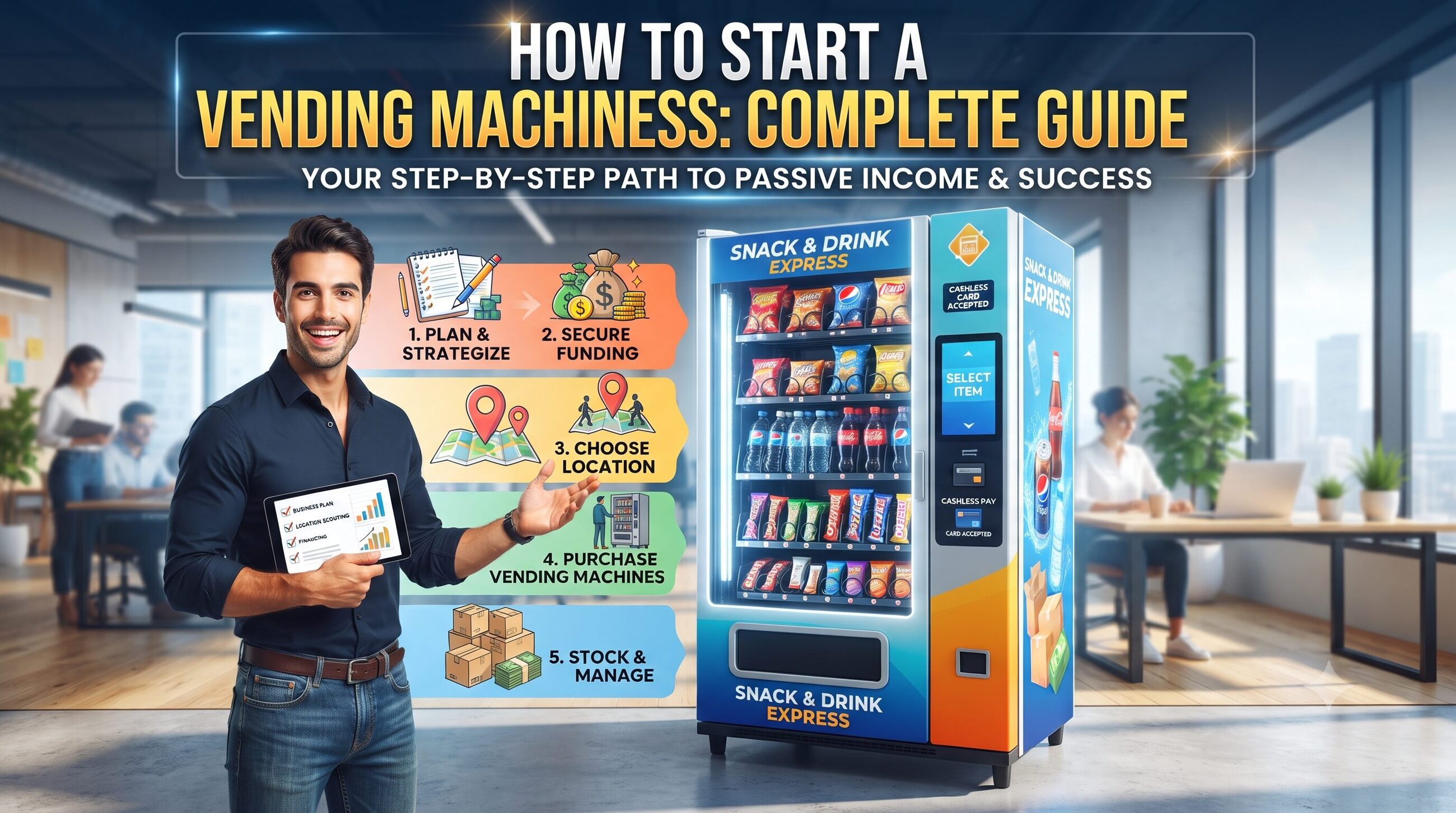
Starting a vending machine business involves choosing a product niche, researching profitable locations, purchasing suitable machines, securing permission to operate, managing inventory, and tracking revenue and expenses. A well-planned vending business can provide a flexible business model, but its success depends on customer demand, location agreements, product margins, equipment reliability, and ongoing operating costs.
Vending machines allow entrepreneurs to sell products such as snacks, beverages, healthy food, personal care items, and selected specialty products without operating a traditional retail store. Depending on the business model, owners can manage machines themselves or hire assistance for restocking, servicing, and other operational tasks.
However, vending is not entirely passive income. Machines require regular replenishment, cleaning, payment reconciliation, maintenance, and inventory monitoring. Poor locations, excessive commissions, product waste, and unexpected repairs can reduce profitability.
Whether you want to start with one machine or build a larger vending operation, a clear vending machine business plan helps you estimate startup costs, identify suitable customers, assess competitors, and plan for sustainable growth.
This complete guide explains how to start a vending machine business in 2026, what to include in a business plan, how to choose locations, how to estimate costs, and how to prepare a vending machine proposal for property owners and potential partners.
Key Takeaways
A vending machine business sells products through automated machines placed in locations where customers need convenient access.
The first steps are market research, niche selection, location approval, startup budgeting, and machine selection.
A vending machine business plan should cover the target market, product selection, operations, marketing, financial projections, and growth strategy.
Location quality, customer demand, product margins, and operating expenses influence profitability.
Before buying a vending machine, confirm that the equipment suits your products, payment requirements, location, and maintenance capabilities.
A vending machine proposal helps you present your business model to property owners, facility managers, and potential partners.
Startup costs can include equipment, inventory, transportation, installation, permits, insurance, payment processing, and location fees.
A successful vending business requires consistent restocking, machine monitoring, preventive maintenance, and accurate financial records.
1. What Is a Vending Machine Business?
A vending machine business is a retail operation that sells products through automated machines. Customers select an item, complete payment, and receive the product without needing assistance from a cashier.
Entrepreneurs can own and operate their machines, lease equipment, enter into franchise arrangements, or work with property owners under location agreements.
The business can operate in offices, residential buildings, gyms, hospitals, factories, hotels, educational institutions, and other suitable locations, subject to property permissions and applicable regulations.
How Does a Vending Machine Business Work?
A typical vending operation follows this process:
Select a product category based on customer demand.
Identify and obtain permission for a suitable location.
Purchase or lease an appropriate vending machine.
Source products from wholesalers or approved suppliers.
Set prices that account for product costs and operating expenses.
Install the machine and configure payment methods.
Monitor sales, restock products, and resolve technical issues.
Review financial performance and improve the product mix.
Revenue comes from product sales. The amount remaining after product costs and operating expenses determines whether the business is profitable.
A vending machine is not automatically profitable simply because it operates without a full-time cashier. Its financial performance depends on sales volume, margins, location costs, and operating efficiency.
2. Why Do You Need a Vending Machine Business Plan?
A vending machine business plan is a document that explains how you intend to establish, operate, finance, and grow your vending business.
It provides a practical framework for evaluating opportunities before investing money in equipment and inventory.
Define Your Business Goals
A business plan helps you decide whether to start with one machine, operate several machines in a specific area, or build a larger vending network.
You can establish goals for monthly sales, machine utilization, inventory turnover, customer satisfaction, and expansion.
Estimate Startup Costs
Before buying a vending machine, identify the expected costs of equipment, initial stock, delivery, installation, payment systems, insurance, permits, and location access.
A realistic budget should also include working capital for restocking, repairs, and unexpected expenses.
Evaluate Potential Locations
A business plan helps you compare locations based on customer traffic, product demand, operating hours, competition, accessibility, and location fees.
A busy location is not necessarily profitable if customers do not purchase your products or the commission is too high.
Support Funding Applications
Lenders, investors, or business partners may request a plan that explains your business model, investment requirements, market opportunity, and financial assumptions.
Financial projections should be supported by reasonable estimates rather than guaranteed revenue claims.
Plan for Long-Term Growth
A documented strategy makes it easier to determine when to add machines, introduce new products, hire support, or expand into another area.
3. What Should a Vending Machine Business Plan Include?
A comprehensive vending machine business plan template should cover the following sections.
3.1 Executive Summary
The executive summary provides a concise overview of your proposed business.
Include:
Business name and operating location.
Products you plan to sell.
Target customers.
Business ownership model.
Initial investment requirements.
Planned locations.
Revenue and expense assumptions.
Short-term and long-term goals.
Write this section after preparing the rest of the plan so that it accurately reflects your strategy.
3.2 Business Description
Describe your business, the products you will offer, and the value you intend to provide.
For example, a vending business might specialize in healthy snacks and beverages for office workers, while another might focus on convenience products for gyms or residential buildings.
Explain how your offering differs from nearby alternatives. Possible differentiators include carefully selected products, cashless payments, reliable restocking, specialized product categories, or convenient operating hours.
3.3 Market Analysis
Research the potential customers and locations in your target area.
Consider:
Customer demographics and preferences.
Expected foot traffic.
Operating hours and customer routines.
Existing vending machines and nearby retailers.
Product availability and supplier costs.
Potential location fees or revenue-sharing requirements.
Seasonal changes in demand.
Where possible, collect evidence through site visits, discussions with property managers, customer surveys, and available sales data.
3.4 Products and Services
List the categories of products you plan to sell and explain why they suit your target customers.
Potential categories include:
Chips, biscuits, and packaged snacks.
Bottled water and other beverages.
Candy and confectionery.
Healthy snacks and protein bars.
Personal care and convenience products.
Selected electronics accessories.
Workplace supplies or other specialized items.
Product selection should reflect the location, machine capabilities, product shelf life, supplier availability, and applicable regulations.
3.5 Operations Plan
Explain how the business will function day to day.
Include equipment procurement, supplier relationships, installation, inventory management, restocking, cleaning, maintenance, payment reconciliation, and customer support.
If you plan to operate several machines, consider how to organize routes so that travel time and transportation costs remain manageable.
3.6 Marketing and Sales Strategy
Describe how you will secure locations, build relationships with property owners, and make your machines attractive to customers.
Potential activities include direct outreach to property managers, a professional website, local business networking, location-specific promotions, and customer feedback collection.
3.7 Financial Plan
Prepare estimates for:
Initial equipment investment.
Inventory and replenishment.
Delivery and installation.
Permits, registrations, and insurance.
Location rent or commissions.
Payment processing.
Transportation and labor.
Repairs and maintenance.
Revenue, gross profit, and operating profit.
Break-even point and cash flow.
Use realistic assumptions and review actual performance after launch.
3.8 Growth Plan
Explain how you will expand if the business performs well.
Options include adding machines in nearby locations, introducing new product categories, negotiating supplier discounts, investing in remote monitoring, or hiring a route operator.
Expansion should be based on demonstrated performance and available cash flow rather than an arbitrary machine-count target.
4. How to Start a Vending Machine Business Step by Step
If you are wondering how to start a vending machine business, follow this process to reduce avoidable risks and make informed investment decisions.
Step 1: Research the Market and Choose a Niche
Start by identifying a customer group and a product category.
For example:
Offices may need snacks, beverages, and convenient refreshments.
Gyms may support demand for water, sports drinks, and suitable packaged snacks.
Residential buildings may need everyday convenience products.
Factories may require refreshments for employees during different shifts.
Hotels may offer opportunities for travel essentials or packaged snacks.
These are potential use cases, not guarantees of demand. Research the specific location before committing to a machine or inventory.
Step 2: Prepare a Startup Budget
Estimate how much capital you need to launch and operate until the business becomes financially sustainable.
Your budget should include equipment, inventory, transportation, installation, payment systems, insurance, applicable permits, location costs, and a contingency reserve.
Do not spend your entire budget on the machine. You also need enough working capital to replenish stock and manage unexpected expenses.
Step 3: Find and Evaluate Locations
Location selection is one of the most important decisions in vending.
Look for places where your intended customers spend time and can conveniently access the machine.
Evaluate:
Daily foot traffic.
Customer demand and purchasing habits.
Existing vending or retail competition.
Opening hours and access restrictions.
Electrical and connectivity requirements.
Security and vandalism risks.
Delivery and restocking access.
Location fees or commission requirements.
Ask property managers about installation conditions, insurance requirements, operating restrictions, contract length, and responsibility for electricity or damage.
Obtain written permission before installing a machine.
Step 4: Decide Whether to Buy, Lease, or Use a Franchise
Each option has different financial and operational implications.
Buying a machine: Provides greater control over equipment and operations, but requires upfront investment and responsibility for maintenance.
Leasing a machine: May reduce the initial purchase cost, but creates ongoing payment obligations and may include contractual restrictions.
Franchise or managed arrangement: May provide established processes or support, but can involve franchise fees, recurring charges, and limitations on product selection.
Compare the total cost of each option, the contract terms, available support, and the expected operating life of the equipment.
Step 5: Choose the Right Vending Machine
Before buying a vending machine, confirm that it can handle your product dimensions, expected sales volume, payment methods, and installation environment.
Important features to evaluate include:
Product capacity and dispensing mechanism.
Cash, card, or mobile payment support.
Remote sales and inventory monitoring.
Energy consumption.
Temperature control, if required.
Warranty and spare-parts availability.
Security and access controls.
Supplier support and repair options.
A new machine may offer a warranty and newer features. A used machine may cost less initially but require additional inspection, repairs, or replacement parts.
Evaluate the total cost of ownership rather than comparing purchase prices alone.
Step 6: Arrange Suppliers and Inventory
Identify reliable suppliers for the products you intend to sell.
Compare wholesale prices, minimum order quantities, delivery charges, product quality, shelf life, and return policies.
Start with a focused product range, monitor sales, and adjust stock based on actual demand.
For perishable or date-sensitive products, use appropriate stock rotation and check expiration dates regularly.
Step 7: Handle Registration, Permits, and Insurance
Business registration, tax requirements, permits, food-related rules, and insurance obligations depend on your country, state, municipality, product category, and operating location.
Check the requirements that apply to your specific business before launch.
If you operate in India, for example, you may need to review applicable business registration, tax, local trade, and food-safety requirements depending on your products and setup. Verify current requirements with the relevant official authorities or a qualified professional rather than relying on a generic checklist.
Step 8: Install and Test the Machine
Coordinate installation with the property owner and follow the equipment manufacturer's instructions.
Before opening, verify:
The machine is securely installed.
Products dispense correctly.
Prices are accurate.
Payment methods work.
The machine is clean and presentable.
Temperature settings are appropriate where relevant.
Network connections and monitoring work if included.
Customers can identify how to report a problem.
Document the installation and keep relevant equipment and supplier information available for maintenance.
Step 9: Monitor Sales and Restock Regularly
Set a restocking schedule based on product demand, inventory capacity, travel distance, and expiration dates.
Review sales reports, empty slots, payment failures, customer complaints, and maintenance alerts where available.
Adjust the schedule as the business gathers more data. Frequent visits to low-performing machines can increase operating costs unnecessarily.
Step 10: Review Performance Before Expanding
Track revenue, product costs, location fees, transportation, payment processing, repairs, spoilage, and other expenses.
Identify which products and locations perform well and which require changes.
Add machines only when you have a repeatable process for selecting locations, maintaining equipment, sourcing products, and controlling cash flow.
5. How to Choose the Best Vending Machine Location
The best vending machine location is not simply the busiest place. It is a location where enough customers are likely to purchase the products you offer at prices that support your costs.
Evaluate Customer Demand
Consider who uses the location, how long they stay, and whether your products meet their needs.
For example, a workplace with limited nearby food options may present a different opportunity from a location with several competing convenience stores.
Compare Location Costs
Some property owners charge fixed rent, while others may request a percentage of sales or another commercial arrangement.
Compare the total cost against realistic sales estimates. A high-traffic location may still perform poorly if fees are excessive.
Check Accessibility and Security
Confirm that customers can access the machine during the intended hours and that your staff can restock it efficiently.
Consider lighting, surveillance, exposure to weather, risk of vandalism, and the security of cash or inventory.
Test Before Committing to Expansion
Where possible, negotiate a trial period or use a contract that provides a reasonable way to review performance.
Track sales and expenses during the trial and compare actual results with your projections.
6. Vending Machine Startup Costs: What Should You Budget For?
The cost of starting a vending machine business varies by machine type, condition, capacity, payment technology, product category, location, and operating model.
There is no single startup figure that applies to every vending business.
Common Startup Expenses
| Expense category | What to consider |
|---|---|
| Machine purchase or lease | Equipment price, deposit, financing, or recurring lease payments |
| Initial inventory | Products, minimum orders, delivery charges, and packaging |
| Transportation | Machine delivery, moving equipment, and restocking travel |
| Installation | Site preparation, electrical work, and setup |
| Payment system | Card reader, mobile payments, transaction fees, and connectivity |
| Location costs | Rent, commissions, deposits, or other contractual charges |
| Registration and permits | Applicable government fees and professional assistance |
| Insurance | Coverage appropriate to the equipment and business |
| Maintenance | Repairs, replacement parts, servicing, and cleaning |
| Working capital | Funds for replenishment, recurring expenses, and unexpected problems |
Request written quotations where possible and keep a contingency reserve for unforeseen expenses.
How to Estimate Your Startup Budget
Use this formula:
Total startup budget = Equipment + Initial inventory + Delivery and installation + Setup and compliance costs + Initial operating reserve
If you are buying several machines, estimate costs separately for each unit and then add shared expenses such as business registration, storage, software, or transportation.
This approach helps prevent underestimating the capital needed to launch.
7. Is a Vending Machine Business Profitable?
A vending machine business can generate a profit when product sales cover the cost of inventory and all operating expenses. Profitability depends on sales volume, product margins, location agreements, machine reliability, restocking efficiency, and the amount invested.
Revenue alone does not show whether a vending business is profitable.
Understand the Main Financial Metrics
Sales revenue: The total amount customers pay for products.
Cost of goods sold: The cost of the products sold through the machine.
Gross profit: Sales revenue minus the cost of goods sold.
Operating expenses: Costs such as location fees, travel, transaction charges, repairs, insurance, software, and labor.
Operating profit: Gross profit minus operating expenses, before any additional financing costs, taxes, or other items not included in the calculation.
Illustrative Vending Machine Profit Calculation
Consider a hypothetical machine with the following monthly figures:
| Financial item | Illustrative amount |
|---|---|
| Monthly sales revenue | ₹60,000 |
| Cost of products sold | ₹30,000 |
| Gross profit | ₹30,000 |
| Location fees and commissions | ₹6,000 |
| Transportation and restocking | ₹4,000 |
| Payment processing and connectivity | ₹1,500 |
| Maintenance and other operating costs | ₹2,500 |
| Illustrative operating profit | ₹16,000 |
These figures are examples for demonstrating the calculation, not industry averages or a prediction of what a machine will earn.
The example excludes any expenses not explicitly listed, which may include financing, depreciation, income tax, owner compensation, or major replacement costs. Your actual results may be significantly different.
How to Calculate the Break-Even Point
The break-even point is the level of sales at which the business covers its costs without making an operating profit or loss under the chosen calculation method.
For a simplified calculation using a consistent contribution margin:
Break-even sales = Fixed operating costs ÷ Contribution margin ratio
For example, if fixed monthly costs are ₹10,000 and the contribution margin ratio is 40%, the simplified break-even sales level is ₹25,000 per month.
This example assumes that the contribution margin correctly accounts for the variable costs associated with sales. If costs vary by product, location, or sales volume, use a more detailed model.
Before investing, prepare conservative, expected, and optimistic scenarios to understand how changes in sales or expenses could affect cash flow.
8. How to Create a Vending Machine Proposal
A vending machine proposal is a document used to present your vending concept to property owners, facility managers, landlords, business operators, or potential partners.
Its purpose is to explain what you want to install, why the location may benefit, how the machine will be managed, and what commercial arrangement you are proposing.
A professional vending machine proposal can make it easier for a property owner to evaluate your offer.
Key Elements of a Vending Machine Proposal
1. Introduction
Introduce your business, the products you plan to sell, and why you are approaching the specific property.
2. Location Opportunity
Explain how the machine could serve the needs of employees, residents, visitors, or customers at that location.
Avoid claiming that the machine will generate a specific amount of revenue unless you have a defensible basis for the estimate.
3. Machine Specifications
Describe the proposed machine, dimensions, product capacity, payment options, installation requirements, and relevant safety or accessibility considerations.
4. Product Selection
List the intended products and explain how they suit the location's customers.
5. Benefits to the Property Owner
Depending on the arrangement, potential benefits may include convenient product access, an additional amenity, revenue sharing, or reduced administrative responsibility for providing refreshments.
6. Commercial Terms
Explain any proposed rent, commission, revenue share, deposit, contract period, utilities arrangement, and other relevant costs.
7. Installation and Maintenance
Describe who will arrange installation, replenish products, clean the machine, handle repairs, and respond to customer complaints.
8. Security and Compliance
Explain the relevant insurance, product-handling procedures, equipment requirements, and responsibilities that apply to the arrangement.
9. Implementation Timeline
Provide a realistic schedule for approval, installation, testing, and launch.
10. Next Steps
Explain how the property owner can request clarification, review the proposed terms, or approve the arrangement.
If you need a ready-made starting point, you can review this vending machine proposal template. Adapt any template to your own business, location, and commercial terms before sending it.
9. Vending Machine Proposal Example
The following is a simplified sample vending machine proposal for a hypothetical office building. Replace the sample information with verified details before using it in a real negotiation.
Proposal Title: Vending Machine Installation for Office Employees
Prepared by: [Your Business Name]
Prepared for: [Property or Company Name]
Proposed location: [Office Building Address]
Date: [Insert Date]
Introduction
We propose installing and managing a vending machine at your office facility to provide employees and authorized visitors with convenient access to selected packaged snacks and beverages.
Our objective is to offer a practical refreshment option while managing stocking, cleaning, and routine servicing according to an agreed schedule.
Proposed Solution
The proposed setup includes:
One vending machine suitable for the selected products.
A product assortment based on the needs of office users.
Cashless payment options where supported.
Regular inventory checks and replenishment.
Routine cleaning and maintenance.
A contact process for reporting faults or payment issues.
Benefits to the Location
The proposed machine may provide employees and visitors with convenient access to refreshments without requiring the property owner to operate a separate retail counter.
The final product range and operating arrangement would be agreed with the property management team.
Commercial Arrangement
The proposed commercial model is:
Location fee or commission: [Insert agreed terms].
Contract period: [Insert proposed duration].
Electricity and utilities: [Specify responsibility].
Installation and maintenance: [Specify responsibility].
Insurance and liability: [Specify agreed requirements].
Implementation Plan
Phase 1: Site assessment and written approval.
Phase 2: Equipment selection and agreement on commercial terms.
Phase 3: Delivery, installation, and operational testing.
Phase 4: Launch, inventory monitoring, and performance review.
Next Steps
We would welcome an opportunity to discuss the location's requirements and agree on the machine specifications, commercial terms, and installation schedule.
Contact: [Name, Email, Phone Number]
Why This Proposal Works
This example identifies the proposed service, explains potential benefits, defines operational responsibilities, and leaves the commercial terms open for negotiation.
A strong vending machine proposal should be specific enough to evaluate while remaining honest about what has and has not been confirmed.
10. How to Market a Vending Machine Business
Although vending machines sell products through self-service, location acquisition and customer demand still require planning.
Build Relationships With Property Owners
Reach out to office managers, facility managers, gym owners, residential property managers, and other relevant decision-makers.
Explain the proposed machine, the products, the maintenance process, and the benefits of the arrangement.
Use a concise introduction and follow up professionally rather than sending generic messages to large numbers of unrelated contacts.
Create a Professional Website
A simple business website can describe your vending services, product categories, service area, contact information, and process for requesting a location assessment.
Include clear details about the locations you serve and how property owners can discuss an installation.
Use Local SEO
If your business targets a specific city or region, create accurate location and service information for your website.
Use relevant local search terms naturally, keep business details consistent, and provide genuine information about your service area.
Do not create misleading location pages or claim to operate in areas you do not serve.
Use Social Media Strategically
Share appropriate updates about new installations, product categories, maintenance practices, and business milestones.
Obtain permission before sharing photographs or identifying a property, customer, or business partner.
Offer a Clear Value Proposition
When approaching a property owner, explain the practical benefits of your service, such as product availability, maintenance responsibility, or a proposed commercial arrangement.
Support claims with evidence when possible and avoid promising a specific increase in revenue or customer satisfaction without reliable data.
11. How to Manage Inventory and Daily Operations
Good operations management helps reduce stockouts, waste, unnecessary travel, and equipment downtime.
Track Product Sales
Record sales by machine and product category.
Use the information to identify popular items, slow-moving products, peak demand periods, and potential pricing adjustments.
Set a Restocking Schedule
Plan visits based on sales velocity, product capacity, expiration dates, and travel costs.
Remote monitoring can help identify when a machine needs attention, but sales and inventory records should be checked for accuracy.
Manage Product Expiration
Use appropriate stock rotation, inspect products regularly, and remove expired or damaged items.
Follow applicable product-handling requirements, especially for temperature-sensitive or regulated goods.
Monitor Payments
Reconcile cash and electronic transactions, review payment-processing fees, and investigate discrepancies.
Cashless payments may make purchasing more convenient for some customers, but their value depends on customer preferences, transaction costs, and technical reliability.
Maintain Equipment
Inspect the machine, payment reader, dispensing mechanism, connections, and other critical components according to the manufacturer's guidance.
Keep maintenance records and establish a process for responding to equipment failures.
Measure Performance by Location
A machine with strong sales may still produce limited profit if location fees, product costs, and restocking expenses are too high.
Evaluate each location separately and use the results to guide product changes, contract negotiations, or relocation decisions.
12. Common Mistakes to Avoid When Starting a Vending Machine Business
Buying Equipment Before Securing a Location
Purchasing a machine without a suitable location can leave you with equipment that generates no revenue.
Better approach: Research demand, assess potential sites, and obtain written location approval before committing to major equipment expenses where possible.
Overestimating Revenue
Projected sales may not reflect actual customer demand or competition.
Better approach: Use conservative assumptions, test locations, and update projections using real sales data.
Ignoring Operating Expenses
Transportation, location commissions, product waste, transaction fees, and repairs can reduce profit.
Better approach: Record all costs and calculate the performance of each machine separately.
Choosing the Wrong Products
A product that sells well in one environment may perform poorly in another.
Better approach: Start with a focused product range and adjust it based on customer demand and sales records.
Failing to Check Contract Terms
Unclear agreements can lead to disputes over fees, utilities, equipment damage, access, and termination.
Better approach: Document responsibilities, payment arrangements, contract duration, and exit conditions in writing.
Neglecting Maintenance
Machine failures can interrupt sales and frustrate customers.
Better approach: Follow a preventive maintenance schedule and establish a reliable repair process.
Expanding Too Quickly
Adding machines increases equipment investment, inventory requirements, route complexity, and maintenance responsibilities.
Better approach: Expand after existing machines demonstrate sustainable performance and your operating process can support additional locations.
13. Frequently Asked Questions About Starting a Vending Machine Business
How do I start a vending machine business?
Research your market, choose a product niche, prepare a budget, secure a suitable location, select a machine, arrange suppliers, check applicable legal requirements, install the equipment, and monitor sales and expenses. Start with a manageable operation and use actual results to guide expansion.
Is a vending machine business profitable?
It can be profitable when product sales cover inventory costs and operating expenses. Results depend on location, customer demand, product margins, equipment costs, location fees, maintenance, and restocking efficiency. There is no guaranteed level of income.
How much money do I need to start a vending machine business?
The amount varies according to the machine, product category, location, payment technology, and business model. Prepare a budget covering equipment, inventory, delivery, installation, permits, insurance, location fees, and working capital before investing.
Do I need a business plan for a vending machine business?
A business plan is useful because it helps you evaluate the market, estimate costs, identify target customers, plan operations, and measure performance. It may also be required when applying for certain types of funding or presenting your business to potential partners.
Where should I place a vending machine?
Potential locations include offices, factories, gyms, residential buildings, hotels, and other sites where customers need convenient access to your products. Evaluate actual demand, competition, operating hours, access, security, and commercial terms before choosing a location.
Should I buy a new or used vending machine?
A new machine may offer newer features and warranty coverage, while a used machine may cost less initially. Compare equipment condition, payment compatibility, energy use, repair history, replacement-part availability, and total ownership cost before deciding.
What products should I sell in a vending machine?
Common options include packaged snacks, beverages, healthy snacks, and selected convenience products. Choose products based on customer demand, supplier availability, machine compatibility, shelf life, and applicable regulations.
What is a vending machine proposal?
A vending machine proposal is a document that presents your vending concept to a property owner or potential partner. It usually describes the machine, products, installation requirements, operating responsibilities, commercial terms, and proposed implementation timeline.
How do I get permission to place a vending machine?
Contact the property owner or authorized facility manager, explain your proposal, discuss fees and operating requirements, and obtain written approval. Confirm access arrangements, installation conditions, utilities, insurance, maintenance responsibilities, and termination terms before installation.
How can I calculate vending machine profit?
Subtract the cost of products sold from sales revenue to calculate gross profit. Then subtract relevant operating expenses to estimate operating profit. Include location fees, restocking, transportation, payment processing, maintenance, and other applicable costs.
Can I run a vending machine business part-time?
A small operation may be manageable part-time, depending on the number of machines, locations, product turnover, travel requirements, and maintenance needs. The workload generally increases as the business expands.
Is a vending machine business passive income?
Not entirely. Although transactions are automated, owners still need to manage locations, replenish stock, monitor sales, maintain equipment, resolve problems, and handle financial records. Outsourcing these tasks may reduce personal involvement but introduces additional costs.
Do vending machines need permits or licenses?
Requirements vary by jurisdiction, product category, and location. You may need business registration, tax registration, food-related approvals, local permissions, or other authorizations. Check current requirements with the relevant authorities before operating.
Conclusion
Starting a vending machine business can be an accessible way to enter automated retail, but long-term success requires more than purchasing equipment and filling it with products.
A well-prepared vending machine business plan helps you evaluate customer demand, choose suitable locations, estimate startup costs, plan inventory, and track financial performance. Securing written location agreements, selecting compatible equipment, and building reliable supplier relationships can help reduce avoidable risks.
A professional vending machine proposal can also help you approach property owners and explain the proposed service, commercial terms, and operating responsibilities.
Begin with a focused product range and a manageable number of machines. Monitor actual sales, account for every significant expense, and improve your decisions using reliable operating data. Expand only when your current setup demonstrates sustainable performance.
The most important principle is simple: choose locations based on customer demand, manage costs carefully, and make business decisions using real performance data rather than assumed profits.
With thorough research, clear agreements, reliable maintenance, and consistent financial monitoring, you can build a vending operation that is better positioned for sustainable growth.
Read our other blogs
Top 10 Better Proposals Alternatives in 2026
Top 10 Online Handwritten Signature Generators
How Do You Write an Offer Letter for a Raise? Free Sample
Top 7 Proposal Software for Accountants in 2026
How to Create a Sales Proposal Template That Closes Deals
How to pick the best floor plan software for your needs